MagBIO is an international research and innovation project funded by the European Union’s Marie Skłodowska-Curie Actions Staff Exchange programme. Our mission is to develop a ground-breaking medical technology known as "magnetobots" to improve the way we identify and treat solid tumours, including those associated with lung, breast, colorectal, and prostate cancers. By combining targeted therapies with advanced diagnostic imaging into a single platform, we aim to provide more precise and effective care for patients across Europe and beyond.
One of the greatest challenges in modern oncology is delivering medicine directly to the heart of a tumour without affecting healthy tissue. The MagBIO project addresses this by using nature as an inspiration. We utilise a unique group of bacteria that naturally produce tiny magnetic nanoparticles within their cells. These nanoparticles, called magnetosomes, allow us to guide the bacteria using external magnetic fields, essentially turning them into microscopic, steerable vehicles. Because these organisms naturally thrive in the low-oxygen environments typically found in aggressive tumours, they can navigate to hard-to-reach areas to deliver medicine with incredible precision. This "theranostic" approach allows doctors to see the tumour clearly on MRI scans while simultaneously treating it, reducing toxic side effects for the patient.
The success of MagBIO relies on a collaborative exchange of knowledge between 18 partners located across Europe and the USA. This network brings together universities, research organisations, and industry partners to share expertise in biology, physics, and engineering. By facilitating secondments between academic and commercial settings, we are not only developing new technologies but also training a new generation of leaders in the medical technology sector.
Every aspect of our research is guided by a "safe and sustainable by design" framework. This ensures that the production of our magnetobots is environmentally friendly and meets the highest regulatory standards. Through this interdisciplinary effort, MagBIO is working to bridge the gap between laboratory research and clinical application, paving the way for a more sustainable and personalised future for cancer treatment.
Project Objectives
The MagBIO consortium, comprising 18 partners across Europe and the USA, is focused on the following scientific and strategic objectives:
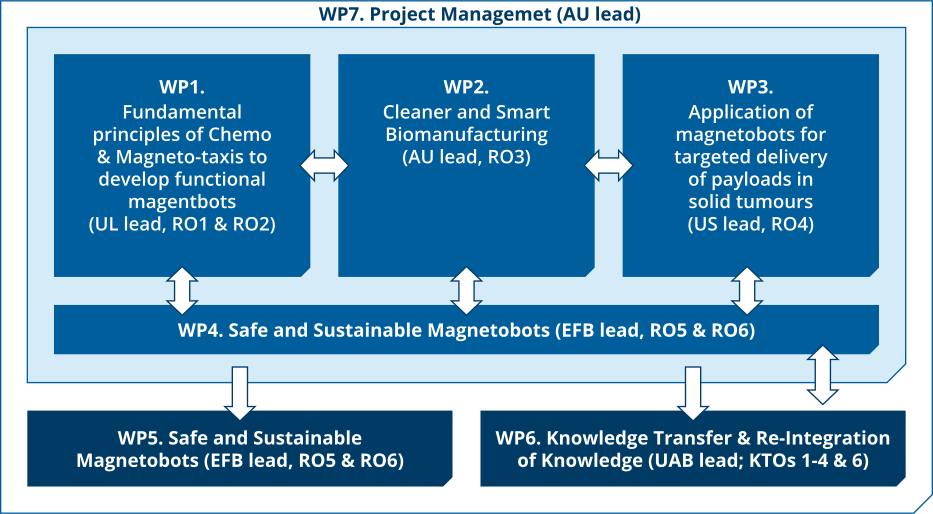
- Engineering and Theranostic Validation: To elucidate the genetic and environmental factors governing the motility and magnetism of magnetotactic bacteria. The project aims to develop functionalised variants for targeted cargo delivery, validating these platforms in pre-clinical settings to achieve over >20% targeting efficiency and a >50% inhibition of tumour growth compared to control groups.
- Sustainable Biomanufacturing and Digitalisation: To establish advanced toolkits for the scalable production of magnetobots under cGMP-ready conditions. By integrating AI/ML-powered process analytical tools, MagBIO seeks to increase bioprocessing yields by 30% and reduce waste by 40%. Central to this is the implementation of a Safe and-Sustainable by Design (SSbD) framework to ensure a 40% reduction in the carbon footprint of the manufacturing process.
- Intersectoral Knowledge Transfer: To reinforce the European Research Area by facilitating a structured programme of over 120 secondments. This effort provides advanced training for 34 early-stage and 33 experienced researchers, bridging the gap between laboratory research and industrial application. The project fosters long-term collaboration across the MedTech value chain, ensuring that at least 80% of participants reintegrate significant technical and leadership expertise into their home institutions.